
An ERP That Follows How Your Business Works — Built Step by Step, Starting with What Hurts Most
Most businesses already have an ERP — it just takes the form of five spreadsheets that reference each other. One for the schedule, one for income, one for costs, one for payroll, and one more for the owner's report. As long as the person maintaining them is careful, it works. The trouble starts as the business grows: numbers get copied from one file to another, a formula breaks without anyone noticing, and the owner only learns whether the month was profitable after days of reconciling at month-end.
We build an ERP that mirrors the workflow your business already runs, then closes the leaks. Our largest example is The Jungle Guide in Bukit Lawang, Indonesia: a trekking, lodging, and restaurant business that used to run on five spreadsheets. Today staff enter a booking once, and the guide schedule, room calendar, euro–rupiah invoices, per-booking costs, team pay and commissions, all the way to the annual profit and loss fill themselves in — with seven roles, each seeing only what they're entitled to.
You don't have to buy everything at once. We start with the one module that causes the most pain today, run it with real data, and add the next module once the first has proven itself.
Narrated in Indonesian, with Indonesian subtitles.
Problems you're probably already feeling
If a few of these sound familiar, it's usually time to fix the system — not to hire more people.
One number, copied into five files
A booking is entered in the schedule, then copied again into the income, cost, payroll, and report files. Every copy is a chance for a typo — and when the numbers disagree, nobody knows which one is right.
No idea what is actually profitable
Revenue is visible, but costs are scattered across receipts, petty cash, and money staff paid out of pocket. Without allocating them to each transaction, unit, or branch, the owner never knows which service really makes money.
Payroll and commissions argued over every month
Commissions are recalculated from a full month of notes, then a cancellation or correction gets forgotten. Either the owner or the team loses out — and both erode trust.
Customer balances forgotten
The deposit came in, the balance didn't, and nothing reminds anyone. Small open balances pile up without ever showing in one place.
Off-the-shelf ERP is too rigid
Packaged software makes the business follow its flow. The moment you have a rule of your own — profit sharing, tiered commissions, two currencies, several business units — the team goes back to a spreadsheet on the side.
What a system like this usually needs
Enter it once, every part fills in
A transaction is recorded once. Schedules, invoices, costs, commissions, and reports all read the same data — no more copying numbers between files.
Finance all the way to profit and loss
Income, expenses, cost per transaction, profit per business unit, cash flow, and an annual P&L with asset depreciation — ready for the owner without re-reconciling.
Payroll, commissions, and advances, automatic
Wages, per-transaction commissions, cash advances, and deductions are collected per person per month, including corrections when a customer cancels after a commission was paid.
Several business units in one system
Hotel, restaurant, and tours — or branches and warehouses — keep their own records, while shared costs and profit splits are calculated by the system. Two currencies supported.
Access locked per role
Owner, accountant, admin, and field team each see only their part. The rules are enforced on the server, not merely hidden on screen.
Edit history, month-end close, and backups
Every change records who made it and when. Closed months are locked and only the owner can reopen them. Data is backed up daily.
It doesn't have to be complete from day one
Almost every project we do starts smaller than the owner first imagined — so the system is in use quickly, and what comes next is decided by real usage, not guesswork.
First version
Enough to stop the problems above and get the team using it.
- Core transaction entry (bookings, orders, or sales) by admin
- Invoices and payment status per customer
- Cost per transaction and daily summary
- Basic roles and access (owner, admin, team)
- Monthly owner report as PDF
Can come later
Added step by step once the first version is running.
- +Team payroll, commissions, and cash advances
- +Profit and loss, cash flow, and reports per unit or branch
- +Field team app (works when the signal drops)
- +Stock, inventory, and assets
- +AI for repetitive work, such as reading receipts and documents
We've built this before
ERPs we have built that run on real data:
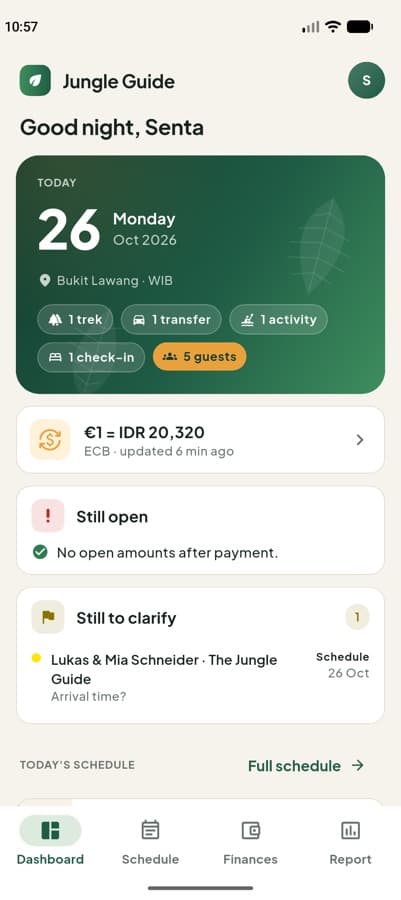
The Jungle Guide — Operations & Finance System for a Trekking, Hotel & Restaurant Business
Trekking, a hotel, and a restaurant in Bukit Lawang now run on one ERP system that replaced five spreadsheets. Enter a booking once — the guide schedule, rooms, euro–rupiah invoices, per-trek costs, team pay and commissions, and the owner's financial reports fill themselves in and can be checked anytime. Seven roles, each seeing only what they're entitled to.
See the full case study →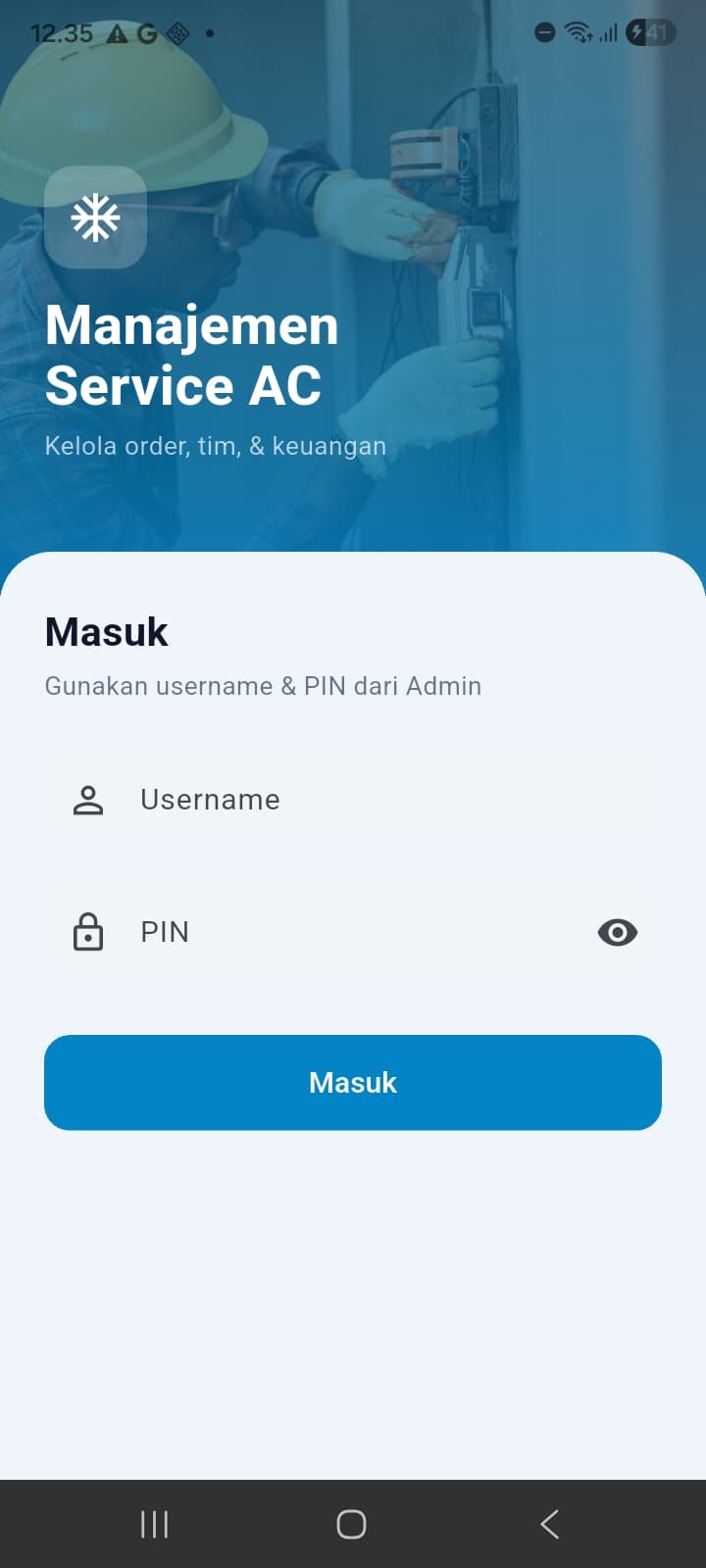
AC Service Management — Operations & Finance System for a Field Service Business
From WhatsApp orders to the owner's financial report in one system. Technicians claim orders from a daily queue, commissions land in each wallet the moment a job is done, the insurance fund is deducted automatically — no month-end manual reconciliation.
See the full case study →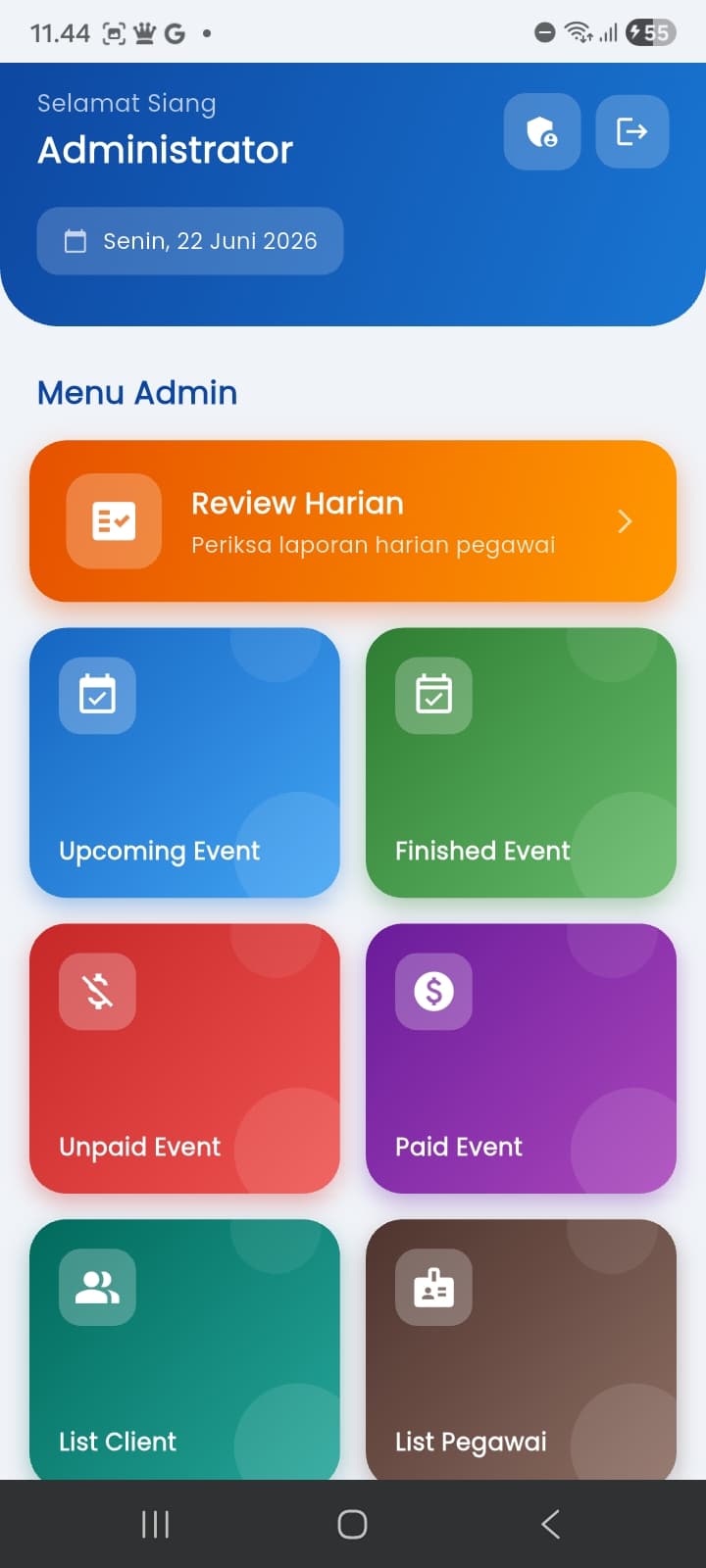
Bali Kei Hire — Operations & Payroll System for an Event Rental Business
Events, teams, and payroll in one system for an event equipment rental business in Bali. Admins assign crews and drivers per event, staff submit daily reports from their phones, and fines, cash advances, and wages are calculated all the way to a PDF payslip.
See the full case study →How the work is done
Estimated durations for the first version. Exact numbers are agreed once the scope is clear, and progress is reported regularly.
Workflow mapping & spreadsheet teardown
We take apart the spreadsheets and formulas you use today one by one, then follow a single transaction from the moment it arrives until the money is recorded. The result is a workflow map and the order of modules.
Core module
The first module is built on a data model already prepared for the next ones — so adding modules later doesn't mean tearing things down.
Run side by side with the old way
The system runs alongside the old spreadsheets until the numbers match. Only then are the spreadsheets retired.
Next modules
Added one at a time by priority and budget, on top of data that is already running.
A safe engagement from kickoff to handover
We know handing a project to a developer is a big decision. So we share the risk with you — you don't carry it alone.
30-day bugfix warranty
Any bug found within 30 days after handover is fixed for free — no extra charge.
Milestone-based payments
Pay per milestone agreed up front, not everything in advance. You always see progress before paying the next stage.
Source code 100% yours
All code and access (repository, hosting, database) are handed over in your name. No lock-in to us.
Regular progress reports
Routine progress updates via WhatsApp, previews included. You always know exactly where the project stands.
Frequently asked questions
How is this different from Odoo, Xero, or QuickBooks?
Packaged software is excellent for work that is the same in every business, such as standard bookkeeping and tax invoices. A custom ERP is needed when the way you work is what sets your business apart: profit sharing between units, tiered commissions, two currencies, or field workflows that no module covers. The two can also be combined — operations in the custom ERP, tax bookkeeping in your accounting software. If packaged software turns out to be enough for you, we will tell you so.
How much does a custom ERP cost?
An ERP with many roles, several business units, and financial reports falls in our complex tier: IDR 25–100 million. Because it is built step by step, a first version with one core module can start in the mid tier: IDR 10–25 million. The exact range is set after the workflow mapping.
How long until we can use it?
The first module is usually ready to use within 6–10 weeks, including the period of running side by side with the old spreadsheets. Further modules follow every 3–6 weeks.
Can we keep the data and formulas from our spreadsheets?
Yes — that is exactly where we start. The formulas in your spreadsheets are business rules that have already been tested in practice; we take them apart one by one and turn them into system logic covered by automated tests. Master data such as customers, prices, and staff is imported once at the start.
How safe is our financial data?
Access is locked per role on the server, every change is recorded in the history, closed months are locked, and data is backed up daily. The server and database accounts are in your business's name, not ours.
What if we want to switch developers one day?
The source code, database, and all access become yours at handover, together with documentation. Another developer can continue without starting from scratch. There is a 30-day bug-fix warranty, and an optional monthly maintenance plan if you want the system to keep growing.
We're not based in Jakarta — or not in Indonesia. Does that work?
Yes. Systems we've built are in use in Bukit Lawang (North Sumatra), Bali, and West Papua. Workflow mapping happens over video calls with screen sharing, and at every stage you try the results yourself on your phone and computer.
Ready to build your custom ERP?
The initial consultation is free. Tell us what you need and we'll help find the solution that makes the most sense for your business.