

Lodging, Tours, and a Restaurant in One System — From Booking to Profit and Loss
A tourism business is rarely just one business. There are rooms to rent, tours or treks to sell, a restaurant serving guests and walk-ins, transport, and often guides and agents paid per guest. Hotel software only handles the rooms, a point-of-sale app only handles the restaurant — everything else goes back into spreadsheets, and the owner only learns whether the month was profitable after reconciling it all at month-end.
We built a system like this for The Jungle Guide in Bukit Lawang, North Sumatra, Indonesia: orangutan treks, bungalow lodging, a restaurant, and guest transport that used to run on five spreadsheets. Now a booking is entered once, and the guide schedule, room calendar, euro–rupiah invoices, per-booking costs, commissions, team pay, the restaurant profit split, all the way to the annual profit and loss fill themselves in.
It is built step by step. We start with the part that hurts most today — usually bookings and guest invoices — and the next module follows once the first has proven itself.
Problems you're probably already feeling
If a few of these sound familiar, it's usually time to fix the system — not to hire more people.
Rooms booked twice
Bookings arrive by WhatsApp, email, and agents. When the room calendar lives apart from the tour schedule, one unit can be sold twice for the same night — and you find out when the guest arrives.
Priced in foreign currency, paid in rupiah
Guests are quoted in euros or dollars, then pay in rupiah, by card, or partly up front. The rate is worked out by hand on every invoice, and the difference is never recorded anywhere.
No idea which tours actually make money
Guide, porter, transport, and meal costs are paid per trip, but one trip carries several bookings. Without splitting them per booking, the owner only sees revenue — not profit.
Guide and agent commissions argued over
Commissions are counted per guest or per tour type, then a guest cancels after the commission was paid. The month-end recap turns into a recount.
The restaurant and the lodging cover for each other
Kitchen shopping feeds guest breakfasts, restaurant cash covers hotel needs. Without two-way records, the restaurant profit split is never clear.
What a system like this usually needs
Book once, every schedule fills in
Tours, treks, transport, activities, and rooms live in one schedule. The guide schedule and room calendar read the same data, with a warning when one unit is booked twice.
Multi-currency invoices
Prices in euros or dollars, payments in rupiah. Rates can be set manually or follow the daily rate, and are frozen per item when an invoice is saved — an invoice already sent never changes value.
Deposits, balances, and card-terminal checks
Every payment is linked to its booking. Open guest balances are flagged on the dashboard, and the daily card-terminal total is matched against card payments.
Profit per booking and per business unit
The cost of one trip is split automatically across the bookings on it. The owner sees profit per booking, per unit (lodging, tours, restaurant), cash flow, and the annual P&L.
Commissions, payroll, and restaurant profit split
Guide wages, agent commissions per guest, kitchen and hotel staff pay, and the monthly restaurant settlement are calculated by the system — including corrections when a guest cancels.
Locked roles, and it works without signal
Owner, accountant, receptionist, restaurant manager, and guide each see only their part — guides, for example, never see prices. The app keeps working when the signal drops and syncs once connected.
It doesn't have to be complete from day one
Almost every project we do starts smaller than the owner first imagined — so the system is in use quickly, and what comes next is decided by real usage, not guesswork.
First version
Enough to stop the problems above and get the team using it.
- Booking schedule (tours, treks, transport, rooms) and room calendar
- Invoices with per-item rates, deposits, and balances
- Open guest balances on the dashboard
- Basic roles (owner, receptionist, guide)
- Monthly owner report as PDF
Can come later
Added step by step once the first version is running.
- +Trip costs split across each booking
- +Guide & agent commissions, and monthly team payroll
- +Restaurant module: daily cash, shopping, settlement & profit split
- +Profit and loss, cash flow, and reports per business unit
- +A web version for the office, from the same code as the Android app
We've built this before
A tourism business system we have built that runs on real data:
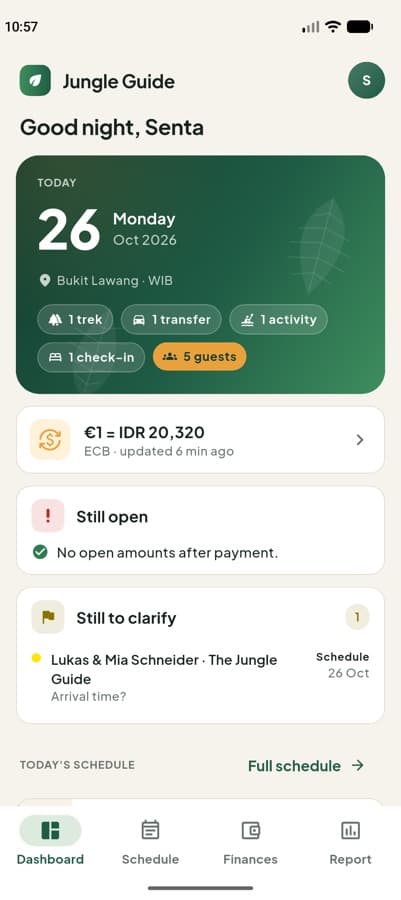
How the work is done
Estimated durations for the first version. Exact numbers are agreed once the scope is clear, and progress is reported regularly.
Workflow mapping & spreadsheet teardown
The booking, room, cost, and payroll spreadsheets you use today are taken apart one by one. We follow one guest from first enquiry until the money is recorded.
Bookings, rooms & invoices
The core module is built on a data model already prepared for finance, payroll, and the restaurant.
Side-by-side run
Used alongside the old spreadsheets until the numbers match, then the spreadsheets are retired.
Next modules
Finance, payroll, restaurant, and owner reports are added one at a time.
A safe engagement from kickoff to handover
We know handing a project to a developer is a big decision. So we share the risk with you — you don't carry it alone.
30-day bugfix warranty
Any bug found within 30 days after handover is fixed for free — no extra charge.
Milestone-based payments
Pay per milestone agreed up front, not everything in advance. You always see progress before paying the next stage.
Source code 100% yours
All code and access (repository, hosting, database) are handed over in your name. No lock-in to us.
Regular progress reports
Routine progress updates via WhatsApp, previews included. You always know exactly where the project stands.
Frequently asked questions
How is this different from a hotel PMS or a channel manager?
Hotel software is great for rooms and OTA distribution. But a tourism business that also sells tours, runs a restaurant, or pays guides per guest usually still reconciles the rest in spreadsheets. A custom system brings those parts together. If rooms are all you need, off-the-shelf hotel software is probably the better fit — and we will tell you so.
Can it connect to Booking.com, Airbnb, or other OTAs?
The Jungle Guide system does not use an OTA integration, because its bookings come in directly and through agents. If you need one, the options — usually through the channel manager you already use — are assessed during workflow mapping, before any cost commitment.
We're remote and the signal is weak. Will it work?
Yes. The Android app keeps working when the signal drops — bookings made offline sync once connected. Workflow mapping happens over video calls, and in North Sumatra we can come in person.
How much does it cost?
A full system with several business units falls in our complex tier: IDR 25–100 million. A first version — bookings, rooms, and invoices — can start in the mid tier: IDR 10–25 million. The exact range is set after workflow mapping.
Our staff prefer English. Is that possible?
Yes. The Jungle Guide app uses English business terms throughout, matching how its team works.
Who owns the data and the source code?
The server and database accounts are in your business's name. The source code and all access are handed over at handover, with a 30-day bug-fix warranty.
Ready to build your tourism & hospitality ERP?
The initial consultation is free. Tell us what you need and we'll help find the solution that makes the most sense for your business.